
6 Fun Halloween Activities for Your ASL Classroom This October
October is the perfect time to bring a little Halloween fun into your ASL classroom! Students are ready for seasonal activities, and teachers are looking


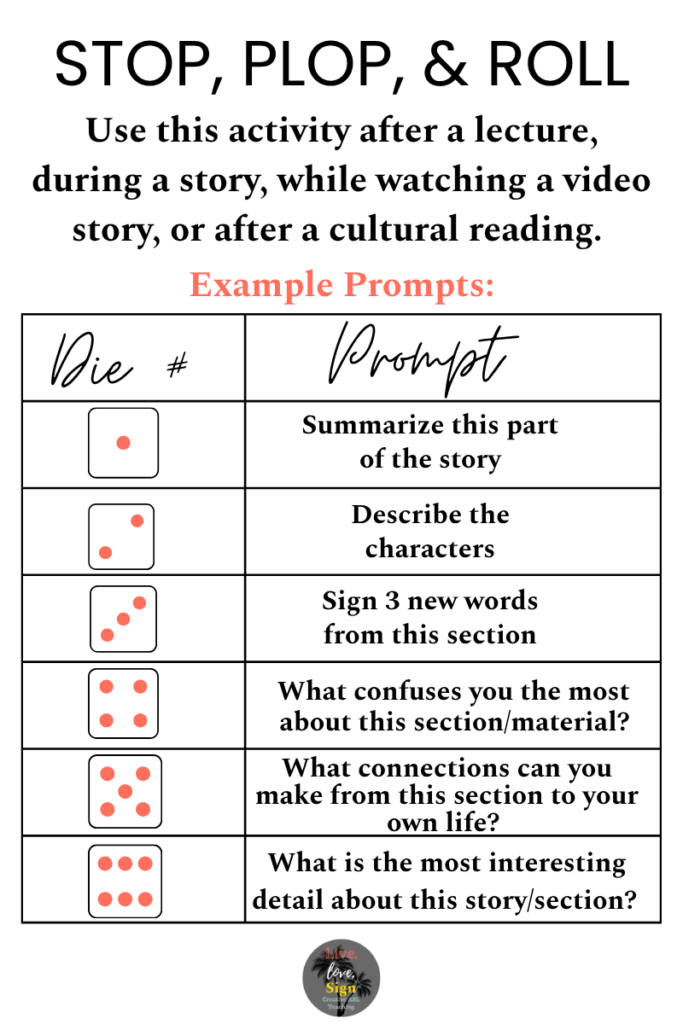
You know I love a good dice game! So, when a colleague shared an instructional strategy with me called Stop, Plop, and Roll, I was immediately intrigued. They know how much I love finding creative ways to bring dice into the classroom, and this activity had me thinking about all the ways I could adapt it for my ASL students.
After checking out the strategy from lead4ward, I started brainstorming ways to use this idea in my own classroom. I love activities that get students thinking, talking, and participating without requiring a ton of prep from the teacher. This one checks all those boxes!
The original strategy uses partner reading and dice to help students think more deeply about a text. Students take turns reading short sections, rolling a die, and responding to a corresponding question or task. Instead of simply reading and moving on, they stop to process what they have learned and share their thinking with a partner.
But here’s what got me excited: You don’t have to use this strategy only for reading! With a few tweaks, it can become a fun way to review vocabulary, practice comprehension, build conversations, and get students using ASL.
The idea is simple!
Students can work with a partner or in a small group. After responding, they can switch roles, roll again, and continue learning.
The beauty of this activity is that the dice add an element of surprise. Students don’t know which question or challenge they’ll get next, so they have a reason to stay engaged and think on their feet.
Once I started thinking about this strategy, I came up with so many possibilities! Here are a few ways you could use it with your ASL students.
You know I’m all about keeping classroom activities manageable, so here are a few things I’d keep in mind when trying this strategy.
One of the things I love most about teaching is finding a strategy that someone else shares and figuring out how to make it work for my own students. Stop, Plop, and Roll is a great reminder that a simple tool like a die can add variety to classroom practice while giving students more opportunities to think, respond, and communicate.
A big thank-you to my colleague for sharing this idea with me, and to lead4ward for the original instructional strategy and resources, and this video that shows you how it works!
Now I’m curious: How would you use Stop, Plop, and Roll in your ASL classroom? Would you use it for vocabulary review, video comprehension, fingerspelling, or something completely different? Come share your ideas with us in the Creative ASL Teaching Facebook group. I love seeing how teachers take an idea and make it their own!
Thanks for stopping by Creative ASL Teaching! I love sharing ideas that make teaching ASL more creative, fresh, and fun. I hope you found something you can take back to your classroom!
Have a question or want to share an idea? Come join the conversation in the Creative ASL Teaching Facebook group. I’d love to hear from you!
Looking for fresh ideas for your ASL classroom? Explore the Creative ASL Teaching store for ready-to-use activities, games, and curriculum resources.
Want classroom ideas and freebies delivered to your inbox? Join the newsletter and be the first to hear what’s new at Creative ASL Teaching!

October is the perfect time to bring a little Halloween fun into your ASL classroom! Students are ready for seasonal activities, and teachers are looking

As language teachers, we know students need lots of practice. They need to see vocabulary repeatedly, use it in different ways, and have frequent opportunities

Let’s talk about fingerspelling. I know… sometimes it can feel like one of those skills that students either “get” or they don’t. You teach the

One of the biggest challenges in a world language classroom is getting every student to use the target language, not just memorize vocabulary. Students need

Back to School Night I don’t know if you are like me, but Back to School Night makes me incredibly nervous. It does not matter

Bingo in a bag is a fun way to practice vocabulary and take the responsibility off the teacher during class time. Bingo in a bag
